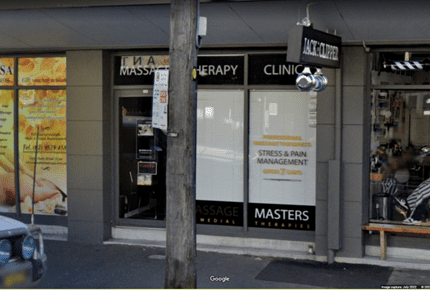
Welcome to Massage Masters Australia
A modern clinic located at the heart of Newtown
Providing you with Professional and Holistic Remedial Massage services
Specialised in Stress and Pain Relief
Includes Health History and Biomechanical Assessment
A massage tailored to your needs
Registered for All Private Health Funds
HICAPS terminal available to claim on the spot
We accept Visa, Eftpos, MasterCard, AMEX, UnionPay, JCB
Myofascial Cupping and Dry Needling
Complementary tools to maximise stress and pain relief
Available as a stand alone therapy or combined with massage
Clinic Services
Remedial Massage Therapy

Remedial massage uses hands-on techniques to release muscle tension, reduce pain, and improve movement. It’s ideal for work or sports injuries, overuse, and postural issues. Your first session includes a short assessment so treatment can be tailored to your needs, whether you require focused relief in one area or a more holistic, full-body approach
Remedial Massage is a clinical, hands-on approach to treating dysfunction within the soft tissues—muscles, tendons, ligaments, and fascia. It aims to reduce pain, release tension, improve mobility, and support the body’s natural healing processes. This treatment is especially effective for work-related strain, sports injuries, overuse conditions, and postural imbalances.
Your first appointment includes a thorough consultation, covering your health history, symptoms, lifestyle factors, and a biomechanical assessment. This helps identify the root cause of your discomfort and allows the therapist to tailor the treatment to your specific needs. Depending on your condition, the therapist may recommend a structured treatment plan—especially for chronic or long-standing issues that require consistent care.
Sessions may involve focused, therapeutic work on a specific area to address acute pain, or a more holistic approach that treats interconnected regions of the body to prevent recurrence and improve long-term function. Techniques can include deep tissue work, myofascial release, trigger point therapy, stretching, and corrective strategies. The goal is to restore balance, improve movement, and support your overall wellbeing.
Triggerpoint Therapy

Trigger point therapy targets tight “knots” in the muscles that can cause local or referred pain. Sustained pressure is applied to release these points, reduce tension, and restore normal muscle function. Clients may feel a strong but manageable pressure that eases as the muscle relaxes, providing longer-lasting relief—especially when combined with myofascial techniques.
Trigger Point Therapy focuses on treating hyper-irritable “knots” within muscle fibres known as trigger points. These points form when muscles become overused, stressed, or unable to fully contract and relax. A trigger point can create local pain or refer pain to other areas of the body, often causing tension headaches, neck stiffness, back pain, or restricted movement.
During treatment, the therapist applies sustained pressure using the fingers, thumb, or elbow directly onto the trigger point. Clients typically feel a strong but tolerable pressure—around 7/10 on a pain scale—while taking slow, deep breaths. As the muscle releases, the pain gradually decreases, and the surrounding tissue softens and warms.
This release helps restore muscle length and function, reduces compensatory movement patterns, and improves overall posture and mobility. Trigger Point Therapy provides longer-lasting relief when combined with other techniques such as Myofascial Release, Deep Tissue Massage or stretching.
Myofascial Release

Myofascial Release uses slow, gentle stretching of the connective tissue (fascia) to ease tension, improve posture, and enhance flexibility. With minimal balm, the therapist lifts and holds the tissue to create a sustained stretch. This technique is generally painless, producing only a mild warming sensation as tight adhesions release and circulation improves.
Myofascial Release focuses on treating the fascia. This is a connective tissue beneath the skin that supports muscles, joints, and blood vessels. When fascia becomes tight or restricted from stress, injury, overuse, or poor posture, it can limit movement and contribute to chronic pain.
This technique involves slowly stretching the fascia using gripping, lifting, and sustained pressure, gradually increasing its length. Treatment typically begins with dry contact, using only a small amount of balm to allow controlled movement without slipping. More balm can be used if the stretching or gripping of the fascia is too uncomfortable.
Clients usually experience little to no pain; instead, they may feel a mild warming or burning sensation. These are adhesions, a sticky glue-like substance that melts, leading to softened tissues and restoration in mobility.
Because fascia plays a key role in supporting healthy blood flow, releasing these restrictions can improve long-term circulation, posture, and flexibility. Unlike oil-based massage, which focuses more on muscle tissue, Myofascial Release creates deeper and longer-lasting changes within the body’s connective tissue network.
If you wish to receive this treatment, simply book for Remedial Massage Therapy. This technique is included throughout the session.
Myofascial Cupping
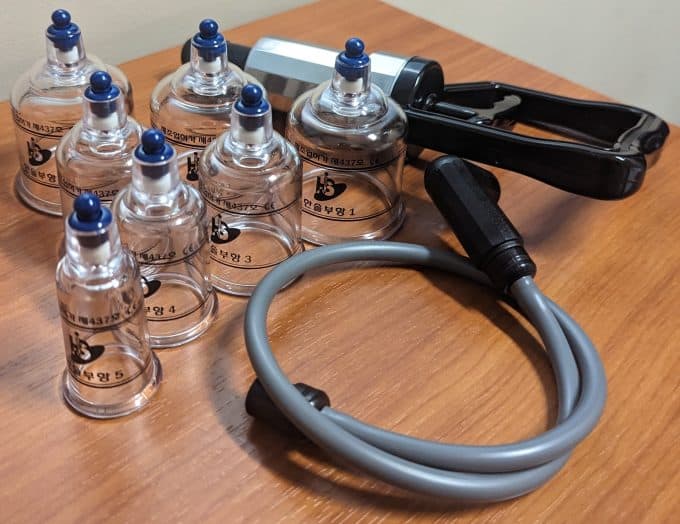
Myofascial Cupping uses a vacuum pump and gliding cups to lift and stretch the skin and fascia. This negative pressure technique quickly reduces fascial tightness, improves mobility, and provides broad, effective relief—often achieving a deeper stretch than hands-on methods alone.
Myofascial Cupping is a technique that uses cups and a vacuum pump to create negative pressure, gently lifting the skin and underlying fascia. Unlike traditional Myofascial Release—which applies downward, sustained pressure—cupping works in the opposite direction, stretching the connective tissue upward. This creates space around muscles, nerves, and blood vessels, enhancing mobility and reducing tension.
The cups are mainly glided across the body (with oil or balm) and rarely left stationary, depending on the area being treated. As the fascia is continuously lifted and stretched, restrictions soften more quickly than with hands-on techniques alone. Negative pressure can also be adjusted to increase the intensity of the stretch, helping further improve flexibility and restore healthy tissue movement.
Myofascial Cupping is particularly effective for broad areas of muscular tightness, postural strain, and chronic fascial restrictions. Clients may experience a light, pulling sensation, followed by warmth and improved mobility. Mild, temporary marks may occur due to increased circulation but usually fade within a few days to a week.
Dry Needling
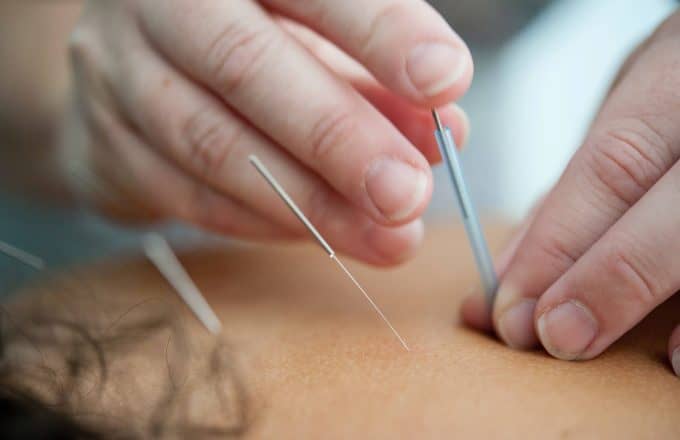
Dry Needling uses fine, sterile needles to release deep muscle trigger points that cause pain and tightness. It targets areas that hands cannot easily reach and is highly effective when combined with remedial massage for faster and longer-lasting relief.
Dry Needling is a clinical technique that involves inserting fine, solid filament needles into specific trigger points within the muscle tissue. These trigger points are tight, hypersensitive knots that often cause local pain, referred pain, and restricted movement.
The goal is to provoke a Local Twitch Response—a brief, involuntary muscle contraction—indicating that the trigger point has been successfully engaged. This response helps reset the muscle fibres, reduce nerve sensitivity, and restore normal muscle function. Clients may feel a brief twitch or deep ache, followed by a noticeable release and reduction in pain.
Dry Needling is particularly effective for deep trigger points that cannot be reached through manual therapy alone. It works best as an adjunct to Remedial Massage and Myofascial techniques by allowing broad muscle tension and surface layers to be released before targeting deeper muscular dysfunction.
This combination offers more effective results for chronic pain, sports injuries, postural dysfunction, and overuse conditions by addressing both superficial and deep muscular restrictions.
It is important to note that Dry Needling is different from acupuncture. While acupuncture is based on Traditional Chinese Medicine and focuses on balancing energy (Qi) through meridian points, Dry Needling is based on Western medicine principles, anatomy, and neurophysiology, with the clinical aim of treating musculoskeletal pain and dysfunction.
General Maintenance

A full-body relaxation massage designed for general maintenance and stress relief. Ideal for clients without specific injuries, it helps prevent the build-up of muscle tension, reduce stress, and support ongoing physical and mental wellbeing.
Available as a Deep Tissue, Sports, or Swedish Massage. (Not claimable through Private Health Funds.)
This treatment is a full-body massage designed for clients seeking general maintenance, relaxation, and stress relief without a specific injury or pain condition. It helps prevent the gradual build-up of muscular tension caused by work, training, lifestyle stress, or poor posture — reducing your risk of future aches, fatigue, and burnout.
Regular maintenance massage supports circulation, improves muscle recovery, promotes better sleep, and encourages overall physical and mental balance. Many clients choose this treatment once a month as part of their self-care routine to maintain long-term wellbeing.
Sessions can be tailored to your preference, including:
Deep Tissue Massage for firmer pressure and muscle recovery
Sports Massage for performance and training support
Swedish Massage for relaxation and nervous system calming
Warming sports oil and heat balm are available for enhanced comfort and muscle relaxation during colder months.
Please note: This treatment is not eligible for Private Health Fund rebates.
Google Reviews
Location
Note, there is a common confusion between two 546 properties. The clinic is located on the street between Raksa Thai Therapies and Machopapi Barber, not the 546 residence. The clinic address is identified as shop 2a/546.